

Gov. DeSantis Eliminates the Environmental Regulation Commission: What Does This Mean?
For more than 50 years, the citizen-led ERC aimed to ensure Florida's water and air quality standards balanced scientific integrity with economic sustainability.
The Central Florida Times is an independent, reader-supported newsletter focusing on the most important local news stories from Florida. Please consider subscribing to and sharing this article.
Florida’s long-standing Environmental Regulation Commission (ERC), a seven-member, non-salaried board responsible for setting key environmental standards, is being eliminated under new legislation aimed at streamlining the state’s rulemaking process.
Created by the Legislature and housed within the Department of Environmental Protection (DEP), the ERC has historically played a central role in shaping policies on the regulation of land, water, and air quality. Its members—appointed by the governor—represent a cross-section of industries and scientific disciplines, ensuring that environmental regulations are grounded in technical expertise, economic analysis, and public health considerations.
The ERC was first established in 1975 as part of the Florida Environmental Reorganization Act. It was designed to serve as a bridge between scientific data and the public interest, with authority to set standards that DEP would implement and enforce. For decades, it functioned as a system of checks and balances, helping ensure that standards for air and water quality were both scientifically sound and economically feasible. Although the ERC operated independently, its decisions were guided by cross-disciplinary evaluation and risk-benefit analysis.
Although the ERC remained the DEP's official standard-setting body, its influence in the rulemaking process has diminished over time. Originally, the ERC held primary authority over environmental standards and even played a role in shaping agency policy and initiating rules. Most recently, its function was more limited to reviewing, approving, modifying, or rejecting rules proposed by the DEP.
The ERC’s Declining Influence and Legislative Shifts
Changes in law—particularly a 2010 measure requiring certain rules to be ratified by the Legislature—have shifted more authority away from the ERC and toward both the DEP and lawmakers. As a result, even rules approved by the ERC may not take effect without legislative approval. Meanwhile, the rulemaking process itself has evolved to allow greater public participation and expanded legal avenues for challenging regulations.
A 2011 Florida Senate report on the ERC found that, despite its reduced authority over time, the commission continued to serve “important functions that cannot be easily replaced, or at all, if it is eliminated.” The report highlighted the ERC’s role in providing an independent forum for public input, offering technical expertise, and reviewing proposed rules from a neutral, citizen-based perspective. It ultimately concluded that the ERC should be retained in its existing form.

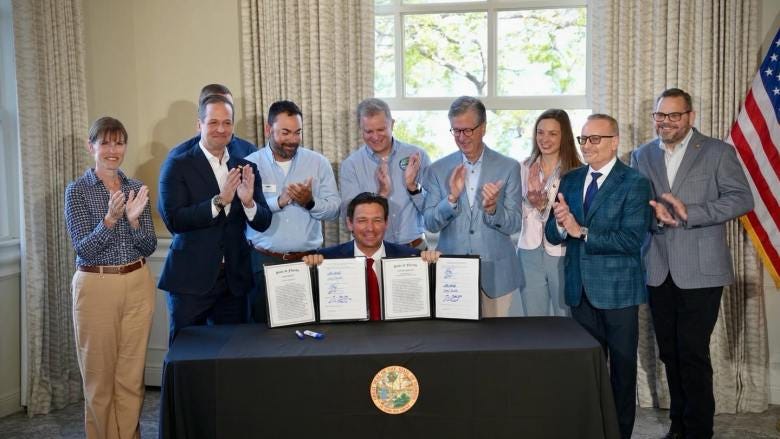
Fifteen years later, however, state leaders contend that the system has become outdated. Over the past 10 years, the ERC met just four times, including a seven-year gap between 2017 and 2024. Last week, Governor Ron DeSantis signed House Bill 1417—one of the first measures signed from the 2026 Legislative Session—eliminating the ERC and transferring greater rulemaking authority directly to DEP. Officials assert that this change will reduce bureaucratic delays and enable more timely updates to environmental standards.
“This change removes redundant steps,” said DEP Secretary Alexis Lambert, adding that the goal is to “update environmental standards more quickly and with less unnecessary red tape.”
Supporters of the measure contend the commission had become a bureaucratic bottleneck, at times struggling to maintain a quorum for meetings. Removing it, they argue, will accelerate regulatory updates and improve administrative efficiency. However, critics warn that eliminating the ERC removes a key forum for public input and independent scientific review. Without this citizen-led oversight, authority to define acceptable pollution levels, for example, will rest largely within the DEP.
Efficiency vs. Oversight: The DEP Takeover
While the ERC operated with curtailed authority in its final years, it remained a unique pillar of Florida’s regulatory framework. As the state’s only citizen-led body authorized to adopt agency rules, it provided a neutral forum for technical expertise and public testimony. To many stakeholders, the commission functioned as an essential checkpoint, ensuring that environmental regulations were transparent, accountable, and thoroughly vetted before implementation.
Ultimately, the dissolution of the ERC may be less a radical shift and more a formal conclusion to a body that had already receded from the forefront of Florida’s governance. The commission’s practical influence had dwindled long before HB 1417 was signed, and the recent action acknowledges that most of its rulemaking authority had effectively shifted toward more direct administrative and legislative oversight. The DEP will now assume full control over environmental rulemaking, with attention focused on whether this shift leads to more agile environmental protection and how effectively the agency can implement and update standards within a streamlined framework. That responsibility includes advancing stricter wastewater and pollution regulations under HB 1417, measures that are expected to increase compliance costs for private industries. While these updates aim to strengthen environmental protections, they have also raised concerns about broader economic impacts. The DeSantis administration maintains the changes align with the efficiency goals of the Florida Environmental Reorganization Act, but a recent fiscal analysis suggests businesses could face “significant” negative impacts as they adjust to a faster pace of regulatory change—now occurring without the added layer of independent, citizen-led review.
To never miss an update, subscribe to the Central Florida Times by clicking the banner below:

it means nasty stuff getting in our water supplies and air etc to furnish the pockets of the companies that will be abusing us